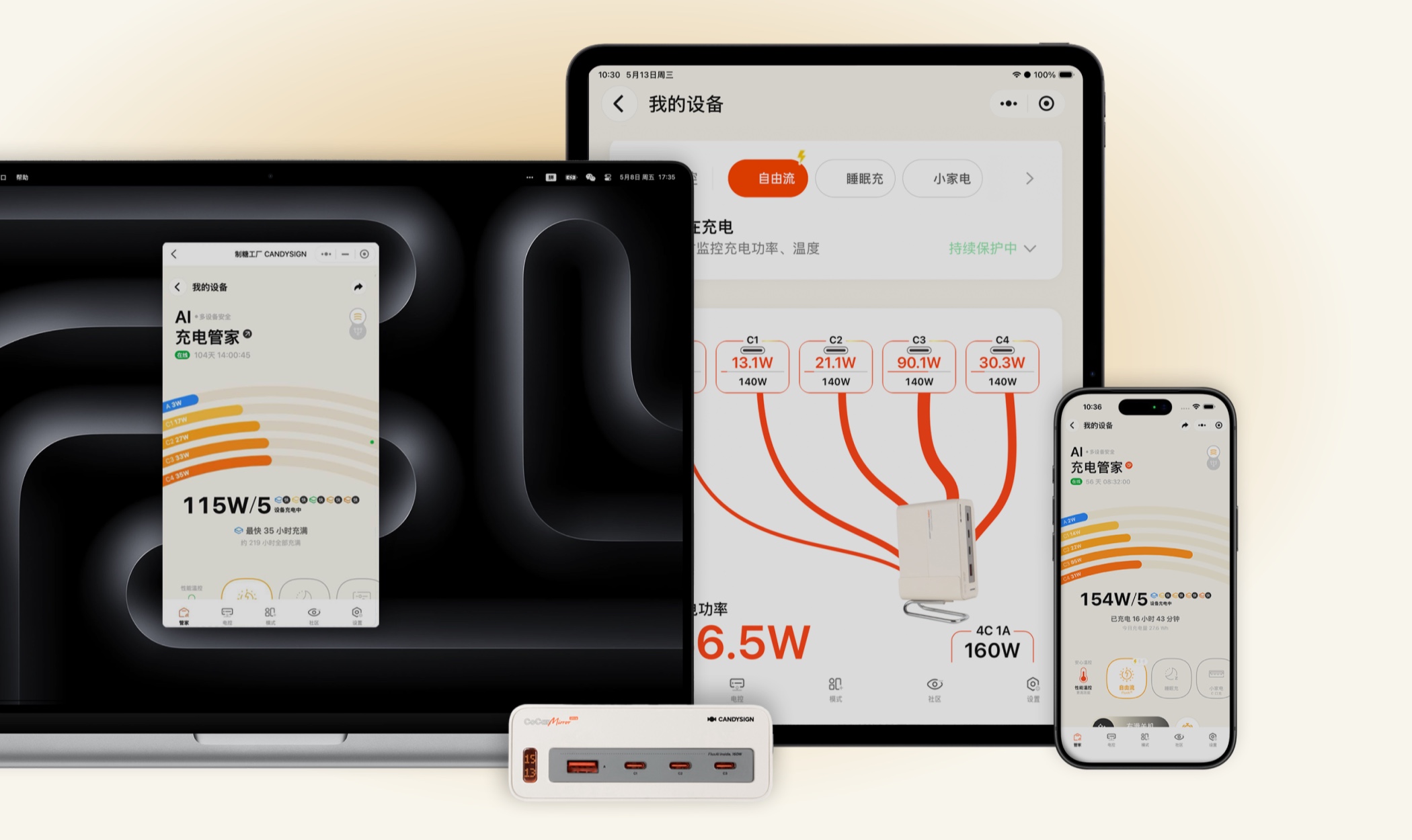
A traditional multi-port design is built on one table: C1 alone gets 100W, C1+C2 get 65W each, fill more ports and it steps down again. The table is fixed at the factory. It does not know how much your laptop draws right now or how much that cable can carry; if a port draws only 21W, the unused headroom still stays locked in place.
FluxAI® has no such table. It treats the full 160W as one shared pool and reads, in real time, each port's PD negotiation, cable eMarker, battery stage, live and historical power, temperature, port priority, and the total budget — then decides, moment by moment, how much power goes to which device. Ports keep reporting real demand, and scheduling completes within milliseconds.
The key is recycling and reuse. When a device enters a low-power stage, FluxAI® immediately pulls its unused headroom back into the pool and routes it to whatever needs it more. In a two-hour test, Mirror delivered about 296.4Wh, roughly 18Wh more than a traditional charging station rated at 250W; with four power banks, it filled them about 20 minutes sooner. The extra work comes from reuse rate, not a larger transformer.