
Get CoCan Mirror

Shopping opens soon.

Scan with WeChat to buy CoCan Mirror

Chip To Cloud, ISO 27001 / 20000 / 9001

From a circuit board to the cloud, trustworthy the whole way.

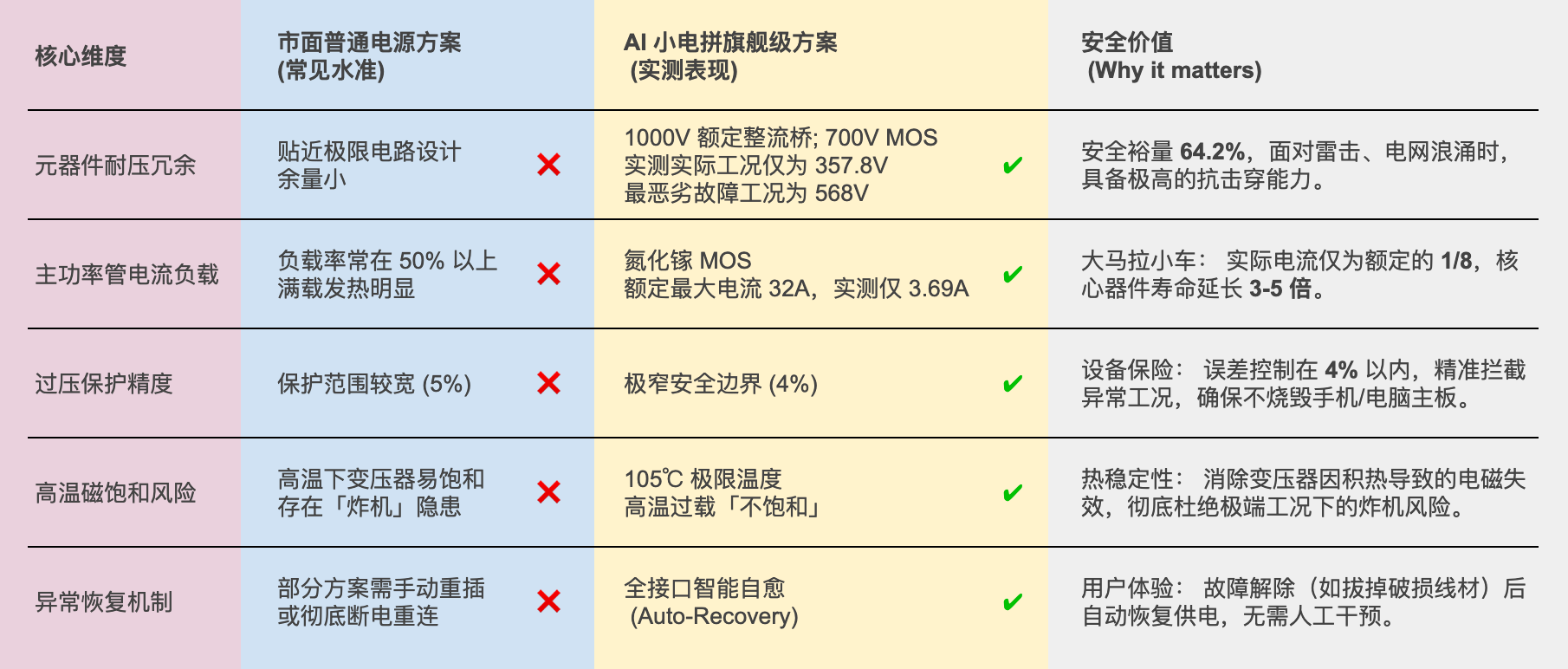
Mirror builds safety on two axes. Electrically it leaves wide margins — physical limits of 105°C, 32A, and 1000V, with 64.2% voltage-tolerance headroom, and an FPGA watching temperature and current a million times a second. For information it runs a chip-to-cloud chain of trust: a unique key per device, encrypted OTA, device-unique certificates, post-quantum encrypted mTLS, and ISO 27001, ISO 20000, and ISO 9001 certification.

A charger that runs flat-out for hours and rides around in a backpack needs generous electrical margin. Mirror's components are rated to physical limits of 105°C, 32A, and 1000V, with 64.2% voltage-tolerance headroom and a current load ratio of just 1/8 — what it actually endures sits far below what it can endure.

The transformer uses a 105°C anti-saturation design that holds up through a long high-energy cruise. Efficiency reaches 93.7% and ripple sits far below the 200mVp-p national-standard ceiling - clean enough for precision gear. The whole design is built to an industrial electrical-safety footing, and it is CCC- and SRRC-certified.

AI CoCan Mirror combines industrial-grade component headroom with highly precise protection, adding dependable insurance for everyday power use and the devices you value.

Electrical Headroom

Push the physical limits far out, and daily use takes care of itself.

Electrical safety headroom comparison between AI CoCan Mirror and conventional power designs

Hardware And Software Guardrails

Hardware senses. Software decides.

The hardware layer watching over safety is the FPGA. The Anlogic EF2-series FPGA includes two embedded 8-channel, 12-bit, 1 MSPS ADC groups, so temperature and current excursions are captured precisely inside a microsecond-scale window. The bottom layer is faster by nature, and more dependable.

On top of that FPGA, Mirror builds intelligent thermal-control software. Within the hardware's redundant safety envelope, the choice goes to the user.

Performance thermal control prioritizes output, and fits most daily fast-charging sessions.

Comfort thermal control prioritizes a steadier surface temperature, for users who care more about how warm the charger feels.

That is the core of an SDC software-defined charger: hardware holds the line, while software shapes a better experience.

Under it all is the same OTA-reconfigurable FPGA — upgrading hardware logic over time while watching every degree and every amp at the lowest layer.


Chain Of Trust

Open interfaces need trust welded into the hardware.

Mirror opens up MQTT, telemetry, and third-party integration. That openness rests on a hard foundation: the chain of trust starts at ESP32 secure boot, runs through an encrypted FPGA bitstream, and lands on signature checks in the SW3566 port-control chips — a triple physical chain of trust locked down by blown eFuses, each link holding the next.

ESP32 enables Secure Boot and Flash Encryption, loading only trusted firmware; the FPGA side keeps no sensitive key material; SW3566 firmware must pass signature verification and bind to the chip eFuse and flash identity, so it runs only on the target chip. Debug access is permanently closed in production.

Every device gets its own unique RSA key on the line — one key per device — and each OTA is encrypted per unit with rollback protection. The production line uses FIPS-standard cryptography, device and cloud authenticate each other with device-unique certificates over post-quantum encrypted mTLS, and a fully automated CI/CD pipeline audits every release. From chip to cloud, the whole operation carries ISO 27001 for information security, ISO 20000 for IT service management, and ISO 9001 for quality management.

Boot Chain

A chain of trust from ESP32 to SW3566

ESP32 Secure Boot Secure Boot and Flash Encryption verify and protect the main controller firmware.
Controlled FPGA Boot ESP32 decrypts and loads the FPGA bitstream; sensitive material stays out of FPGA flash.
SW3566 Signature Check A custom Bootloader verifies firmware signatures for the port controller chips.
Device-Unique Keys TLS certificates, secure-boot keys, and firmware-encryption keys are generated per device during production.

After You Buy It

Security does not stop at the factory.

01

Per-device encrypted OTA

Update packages are dynamically encrypted per device, signed, sent encrypted, and rollback-protected, so the upgrade itself stays safe.

02

Device-unique certificates + post-quantum mTLS

Device and cloud authenticate each other with device-unique certificates over post-quantum encrypted mTLS, protecting control and telemetry traffic.

03

Audited release

Every update is compiled, tested, signed, packaged, and uploaded under Linux through a fully automated CI/CD pipeline, cutting human release risk.

04

Traceable archive

Build records, dependency versions, signed artifacts, and release flow are archived long-term, while published interfaces and open firmware serve as audit entry points, so every OTA traces back to its source.

Tester sign-up

Leave a message