
Learn more

Get CoCan Mirror

Shopping opens soon.

Scan with WeChat to buy CoCan Mirror

The World's First SDC-Based Agentic Charger

Charging freedom for the AI era.

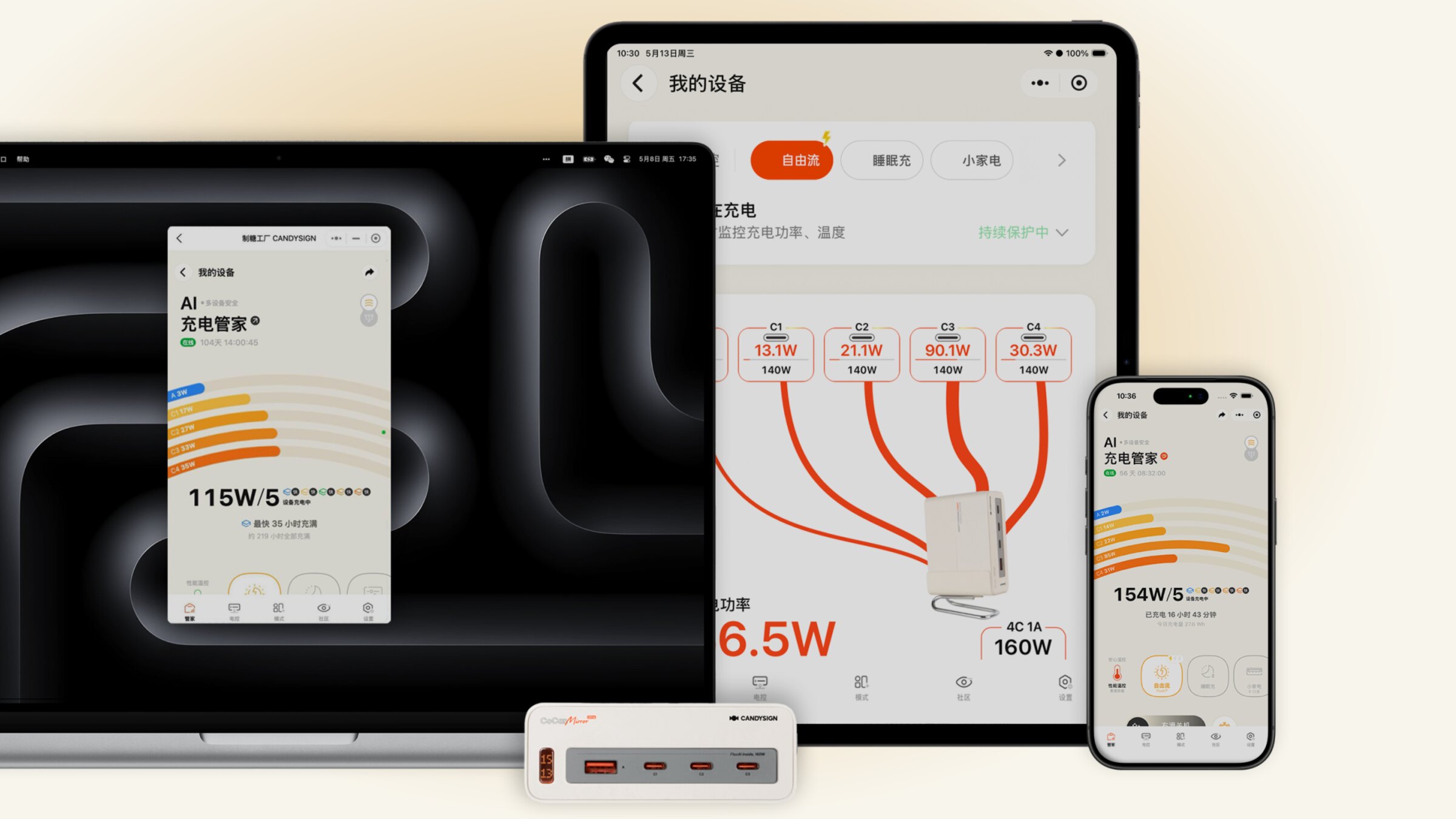
AI CoCan Mirror is the world's first SDC-based agentic charger. FluxAI® makes 160W outrun a traditional 250W. CanOS 2.0 lets an AI drive it directly. And it splits apart to follow you from desk to the road.

CoCan Mirror CP-03
160F>250 power reuse
4×140W same ceiling
31.94cm³ volume per port
AIDC agent-controllable

Why Mirror

One Mirror Beats A Desk Of Chargers

FluxAI® makes 160W out-run a traditional 250W — and it splits apart and takes AI commands.

01

160F > 250

FluxAI® turns the whole unit into a shared power pool, recycling idle watts in real time and sending power wherever it is needed.

02

One Replaces Seven

Assembled it is a desktop power stack; split apart, a travel charger that grips the wall — just 31.94 cm³ per port.

03

An AI Can Drive It

Over MCP it joins agents like OpenClaw to read status, switch strategy, and control ports in plain language.

Whitebook Index

From Experience To Technology

See why FluxAI® and AIDC matter, then go deep on CanOS 2.0, protocols, security, and customization.

01

Software that makes power visible

From live power across five ports to charging modes, history, and protocol control, CanOS 2.0 turns a high-power charger into software you can see and shape.

02

The charging race

Plug devices into five ports whenever you like and pit FluxAI®, Timic™, and a traditional fixed-table charger against the same load — see which fills first, and which keeps every device charging as you add more.

03

Real-time power scheduling

FluxAI® turns the whole unit into one shared power pool: power flows to whatever needs it, idle watts are recycled on the spot, and the link never drops. 160F > 250 is a measured result.

04

The FluxAI® decision engine

FluxAI® is a patented power-reuse algorithm. It drops the Fixed Lookup Table and the port lock, treating the full 160W as one real-time pool, with idle watts recycled into real demand.

05

The detachable desktop form

Mirror splits apart and snaps together: assembled, a desktop power stack with two rear outlets; detached, a travel charger that grips the wall and won't fall. A 0.5-inch amber ingBar screen and three stands make a power supply something you actually want on your desk.

06

A software-defined charger

Mirror was the world's first software-defined charger (SDC); over MCP it now joins AI agents to become a schedulable AIDC. Underneath sits CanOS 2.0: a layered power operating system that reaches from port handshake to edge-cloud sync, and can OTA even the protocol-chip firmware.

07

Full-stack OTA

OTA, protocol OTA, and licensed OTA often get lumped together. They are three different things. CANDYSIGN was the first charger brand known to ship full-stack OTA - updating even the protocol chip - and so far the only one to add new protocols to devices already sold.

08

Broad protocol compatibility

Mirror runs 22 fast-charge protocols: PD 3.2 with AVS and high-watt PPS, Xiaomi 120W Turbo Charging, UFCS 2.0, and more. Full-stack OTA is built to keep adding new protocols.

09

Trust from chip to cloud

Mirror builds safety on two axes. Electrically it leaves wide margins — physical limits of 105°C, 32A, and 1000V, with 64.2% voltage-tolerance headroom, and an FPGA watching temperature and current a million times a second. For information it runs a chip-to-cloud chain of trust: a unique key per device, encrypted OTA, device-unique certificates, post-quantum encrypted mTLS, and ISO 27001, ISO 20000, and ISO 9001 certification.

10

The public MQTT interface

Mirror publishes MQTT v5 topics, protobuf payloads, telemetry fields, and datasheets, and its firmware is open source. The device serves Prometheus and JSON metrics locally alongside a cloud MCP server — use the official cloud, your own broker, Grafana, scripts, or AI tools.

11

AI access and local metrics

A cloud MCP server lets Claude, Cursor, and Codex read and control CoCan directly; agents such as OpenClaw can drive FluxAI® through MCP, while local Prometheus and JSON metrics keep the record. As far as we know, no other charger does this.

12

Observable charging

Telemetry turns charging from a black box into data. See what is happening at a glance; dig deeper and port, protocol, power, temperature, and system events are all laid open to feed your own dashboards and automation.

13

Personalization and strategy

Mirror bends charging to your habits: FluxAI® for everyday top-ups, sleep mode for quiet nights, and appliance Mimic Charge for small-device compatibility. Pro / Ultra unlocks deeper control, OTW upgrades even offline CANDYSIGN chargers, and every surface can change it.

14

Full specifications

Mirror: 160W total output, up to 140W on all four USB-C ports, the world's smallest five-port integration at 31.94 cm³ per port, 93.7% efficiency, and about 18mV ripple. It snaps apart, carries two rear outlets, pairs with the Wingie / Oxie / Rhinie stands, and has taken three annual awards.

Technical Preview

Hardware Sets The Floor, CanOS 2.0 The Ceiling

A layered operating system for power and compute.

CanOS 2.0 splits the charger into layered, extensible systems: FluxAI® scheduling in real time, full-stack OTA that updates even the protocol chips, the OTW cloud-bridge that upgrades older chargers, and MCP that lets AI agents take the wheel. Above the hardware sits software that keeps growing.

device/<psn>/enduser/request/<cmd>
device/<psn>/admin/request/<cmd>
device/<psn>/telemetry/<cmd>

AI CoCan Mirror supports Pro / Ultra, unlocking richer strategy, connectivity, automation, and AI capability on demand.

SDC → AIDC

Hardware sets the floor. CanOS 2.0 sets the ceiling.

AI CoCan was the world's first software-defined charger (SDC). Now it goes further. Over MCP it plugs into AI agents like OpenClaw — reading intent in plain language, correcting its own commands, moving from following orders to grasping what you mean. A power node your AI workflow can call on its own. That is AIDC.

FluxAI®

160W that outruns a traditional 250W.

Traditional multi-port chargers split power by a fixed table, so capacity sits idle. FluxAI® turns the whole unit into one shared power pool: power flows to whatever needs it and idle watts are recycled on the spot, with no dropped connection. In testing it delivered 296.4Wh over two hours — more than a traditional charging station rated at 250W. That is 160F > 250.

One Beats Seven

One Mirror clears a desk of chargers.

Assembled, it is a desktop power stack with two rear outlets for a monitor or a lamp. Split it apart and the charger becomes a travel unit that grips the wall and won't fall, feeding a laptop, phone, tablet, and earbuds at once. At 31.94 cm³ per port it is the world's smallest five-port integration — and with the Oxie stand it unlocks a sustained 160W cruise.

What makes it Mirror

The core of the new CoCan

01

FluxAI®

A patented power-reuse algorithm: no fixed speed limit, idle watts recycled in real time, 160W outrunning 250W.

02

CanOS 2.0

A layered power OS whose full-stack OTA updates even the protocol-chip firmware — capability is not fixed at the factory.

03

AIDC · OpenClaw

Over MCP it joins agents like OpenClaw, so an AI reads and schedules the charger in plain language.

04

ingBar display

A 0.5-inch amber OLED inspired by 1980s terminal aesthetics. It breathes, chimes on the hour, and runs Conway's Game of Life.

It outlasts the spec sheet

A charger can get better the longer you own it.

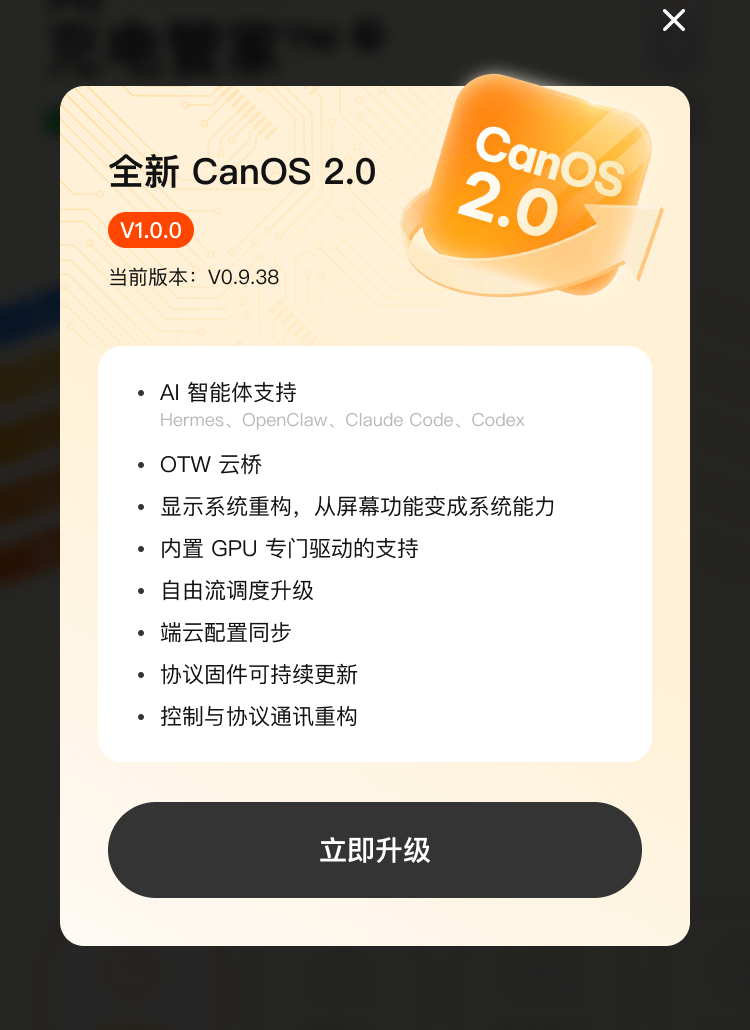
CanOS 2.0 version-upgrade dialog

Most chargers freeze their definition on the spec sheet. The day they ship is the best day they'll ever have.

Mirror hands its lifespan to software. CanOS 2.0 organizes allocation, port priority, display state, provisioning, telemetry, OTA, MQTT, and security into a layered operating system. Hardware sets the floor. CanOS sets the ceiling.

Rarer still is full-stack OTA. CoCan is the industry's first charger that can wirelessly update protocol-chip firmware, FPGA logic, and AI algorithms alike. It shipped more than thirty updates through 2025 and debuted UFCS 2.0 and SPR AVS to the world.

OTW extends this to offline devices. The cloud service can even update CANDYSIGN CANDYSIGN chargers that cannot connect on their own — lifting Huawei Pura 80 peak power from 26W to about 58W.


One does the work of seven

Plug in five devices. It sorts out the rest.

The laptop wants high power, the phone wants a fast top-up, the tablet sits in a meeting, and earbuds or camera batteries need only steady low power. This mix is exactly where Mirror is at its best. All four USB-C ports support up to 140W, so there's no strongest socket to remember and no rewiring the desk when a second device shows up.

The 160W budget is scheduled live, with no fixed split. Device requests, cable capability, PD negotiation, battery stage, temperature, and port priority all feed the scheduler. When one device draws less, the freed budget moves to the port that needs it. The moment the laptop drops into a low-power stage, the phone and tablet gain room.

FluxAI® catches every shift: when to favor the laptop, when to hand budget to the phone, when to switch to a steadier thermal mode. Through it all, renegotiation keeps devices online — still lit, still charging.

Anyone who wants to look deeper can. Port state, power history, protocol handshakes, telemetry, and MQTT data are all kept, so every watt on screen traces back to a reason.

One of a kind

Charging freedom for the AI era — splits, stacks, and powers everything from a phone to your workstation.

Set it on the desk and it is a formidable power stack: four C ports, one A port, and two rear outlets to feed a monitor and a lamp. Pull the fast-charging body out, drop it in a bag, and it is a travel charger that grips the wall and stays put. One machine, two roles.

What lets 160W outrun a conventional 250W is FluxAI® — power becomes one shared pool that flows with demand and is recycled the instant it goes idle, with no port ever locked to a fixed quota. CanOS 2.0 runs on top, so an agent like OpenClaw can drive this charger directly over MCP. The hardware sets the floor; the software sets the ceiling.

Built for Hacksumers, Mirror delivers high-energy cruise for multiple laptops. Add the Oxie stand and it unlocks a sustained 160W at full power for long sessions — a serious boost for your productivity.

Tester sign-up

Leave a message