
Get CoCan Mirror

Shopping opens soon.

Scan with WeChat to buy CoCan Mirror

22 Protocols, Fully Negotiated

Whatever device you own, it keeps pace.

Mirror runs 22 fast-charge protocols: PD 3.2 with AVS and high-watt PPS, Xiaomi 120W Turbo Charging, UFCS 2.0, and more. Full-stack OTA is built to keep adding new protocols.

Every Handshake Covered

22 protocols, from Apple to Xiaomi — every device takes its fastest path.

Common devices on a desk speak different handshake languages: iPhone takes PPS, Xiaomi phones want Xiaomi 120W Turbo Charging, and Huawei uses UFCS 2.0. Mirror runs 22 protocols in all, and all four ports support Xiaomi 120W, so no port is second-class.

It stays current with this generation of PD 3.2: AVS trims voltage in millivolt steps, and high-watt PPS gives a heavy laptop a smoother curve. Beyond that, UFCS 2.0, AFC, QC2.0/QC3.0/QC3.0+, and PE1.0/2.0 fill in the rest; Huawei, OPPO, and vivo reach high power over the public PPS and UFCS standards, and Redmi, Honor, and OnePlus all drop straight into their own fast-charge tier.

The measurements speak for themselves: MacBook Pro 16 at about 139W, iPhone 17 Pro Max around 40W, Lenovo R9000P about 91W, an Anker A1340 power bank at 138.92W, and a Raspberry Pi 5 holding 5V/5A. One charger feeds a whole cabinet of devices.
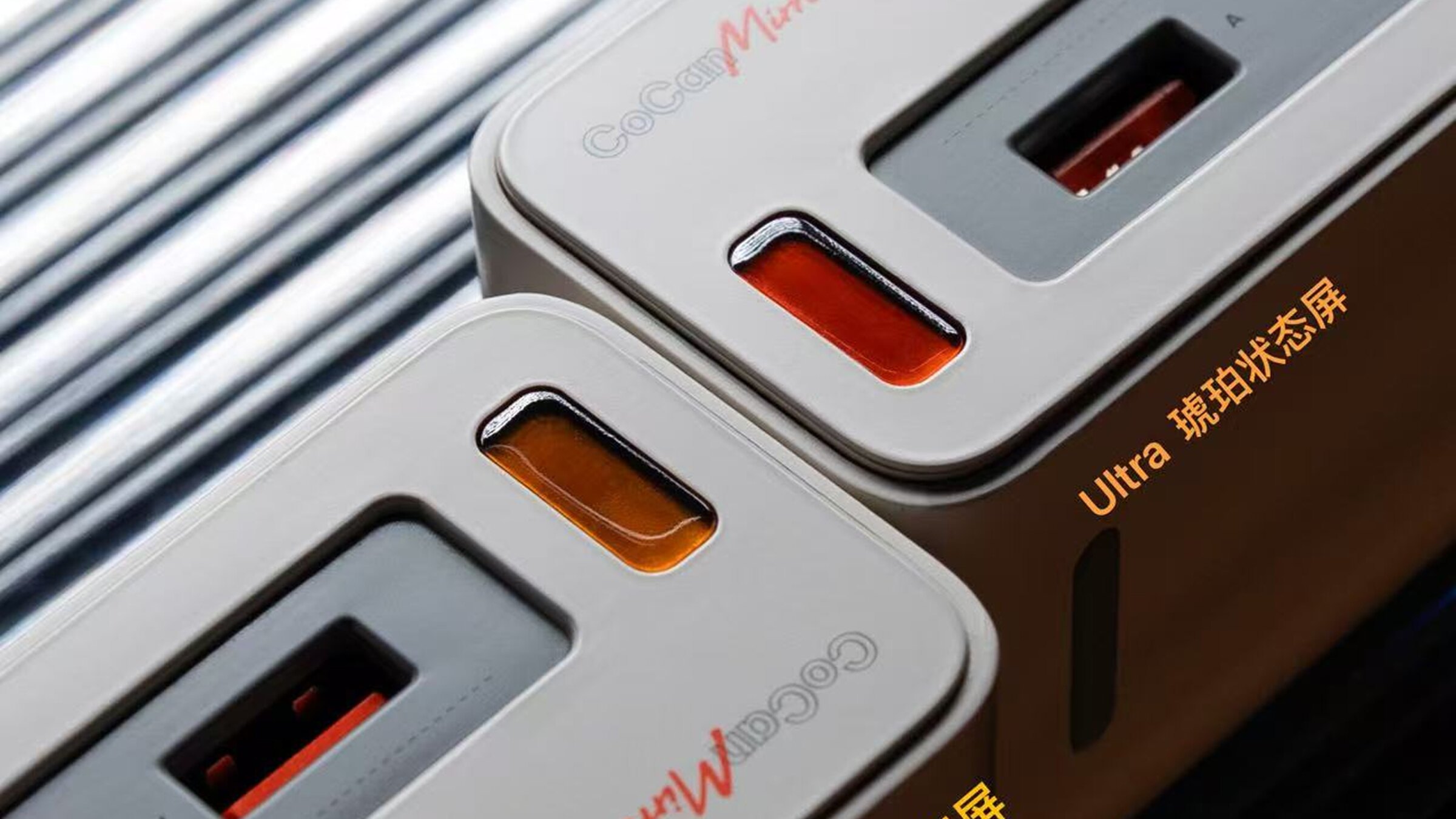

AI CoCan Mirror ports and fast-charge markings
Port Close-Up Protocol coverage ends with every plug-in.

Protocol coverage lands on every device on the desk: laptops, phones, tablets, power banks, and cables.

Protocol List

22 protocols, every one in hand.

PD 3.2 PD, PPS(105W), PPS(55W), AVS, EPR
China fast-charge standard UFCS 2.0 (Huawei / OPPO / vivo public fast charge), Xiaomi Turbo Charging 120W Max (all four ports)
Apple Apple 2.4A
Huawei SCP, HVSCP, LVSCP, FCP
Samsung Samsung 2.1A, Samsung AFC
Qualcomm / MediaTek QC2.0/QC3.0/QC3.0+, PE1.0/2.0
Transsion / Spreadtrum Transsion TFCP, Spreadtrum SFCP
Basic charging BC 1.2

OTA Keeps Adding

The protocol list keeps growing — over the air.

Mirror can OTA its protocol-chip firmware, so the list is never fixed at the factory. It was first in the world to ship UFCS 2.0 and SPR AVS, with 30-plus updates across 2025. When the next standard arrives, existing owners get it too — and CP-02 rides the same CanOS·FluxAI® software line.

PD 3.2 and hundred-watt PPS

Feed modern high-power devices fully, then finely.

Modern laptops, tablets, and handhelds increasingly run on USB-C PD. Mirror supports PD 3.2 — including AVS and hundred-watt PPS — and all four C ports deliver up to 140W within the available budget. A MacBook Pro 16 measured about 139W, a Lenovo R9000P about 91W.

PPS handles the fine work. Many phones and tablets shift voltage and current with battery stage, and hundred-watt PPS opens a finer adjustment range from 3.3 to 21V, so a device draws the best-matched supply its own strategy allows. An iPhone 17 Pro Max measured about 40W — fast when it should be, easing off when it should.

Xiaomi's 120W hyper-charge is folded in too, and every port supports it — no VIP socket reserved for it. Plug into any port and it runs flat out. With FluxAI® scheduling the shared budget dynamically, there's no strongest socket to remember — any one is the right one.

Protocol coverage is only the floor; port behavior has to be tunable too. The firmware exposes port type, compatibility flags, custom PDO voltage, and cable compensation — tune for one device or one cable, and the rest still work out of the box. As the ecosystem shifts year to year, a software-defined protocol layer leaves Mirror room to adapt.

22 protocols

New devices and old, sharing one hub.

A desk never holds just one generation of devices. A new laptop, an old phone, a handheld, camera gear, an earbud case — all charging at once. Mirror covers 22 protocols: PD 3.2, PPS, AVS, EPR, Xiaomi 120W Turbo Charging, UFCS 2.0, AFC, QC2.0/QC3.0/QC3.0+, PE1.0/2.0, TFCP, and SFCP — and Huawei, OPPO, and vivo reach high power over the public PPS and UFCS standards. Ecosystems from different makers and eras share one hub.

Smaller, older, simpler devices are looked after too. The little USB-A things — earbud cases, watch chargers, reading lights, camera accessories — have a USB-A port waiting, so there's no separate legacy charger to pack. An Anker A1340 measured 138.92W, a Raspberry Pi 5 ran at 5V/5A — from accessories to single-board computers, the connection holds.

The cable is the most overlooked variable in compatibility. Current capability, EPR support, eMarker data — all shape the final power. Mirror brings cable capability into state and diagnostics, so when a cable falls short of expected power, there's a clear path to verify instead of guess.

The best compatibility is one less thing to think about: plug in and charge. For an unusual device, there's a place to tune it; for any doubt, there's data to explain it. On the same software mainline, CP-02 is compatible too, so newly added protocols reach the previous generation as well.

Protocols keep growing

The protocol list isn't capped at the factory — it keeps growing.

A device ecosystem never freezes at one moment. New phones bring new thermal strategies, new laptops change PD request behavior, new handhelds ask for different supply stability. Most chargers can do nothing about it — their protocols were sealed at tape-out. Mirror makes compatibility a tunable software capability, with room to spare for later adaptation.

Full-mode OTA is what makes this credible. Protocol-chip firmware updates wirelessly, so new protocols can come later — it's how Mirror debuted UFCS 2.0 and SPR AVS to the world in 2025. The protocol list on the day you unbox isn't the finish line. It's the start.

Those who like to turn knobs have knobs to turn. Custom PDO voltage suits a specific device's supply preference, port type and compatibility flags adjust behavior for different protocol stacks, and cable compensation restores the voltage drop from cable resistance. Ordinary users never need these — yet they can coax a stubborn device into full power.

PD state and cable information enter diagnostics too: VID/PID, eMarker, EPR capability, current, and voltage are all visible. Why a cable limits power, why a device changes speed over time — both can be checked. Protocol coverage, observable state, ongoing OTA — together they're what lets compatibility truly keep moving forward.

One port, every device

22 protocols, settled in a single port.

Plug in fast because the protocols line up. A single Mirror port covers 22 fast-charge standards: PD 3.2 with AVS, high-watt PPS, and EPR; Xiaomi 120W Turbo Charging; UFCS 2.0; AFC; QC2.0/QC3.0/QC3.0+; PE1.0/2.0; TFCP; and SFCP. Huawei, OPPO, and vivo reach high power through the public PPS and UFCS standards, and Xiaomi's 120W mode runs on all four ports — pick any one and it goes full.

High-power USB-C is a deal struck three ways: charger, cable, device. The charger offers a high tier, the device must request the matching PDO, and the cable has to allow that current and voltage. When one link falls short, output backs off, and Mirror surfaces that negotiation so the gap is easy to spot.

The cable is often the hidden variable: weak current rating, a missing eMarker, no EPR support, or resistance-driven voltage drop all pull the measured power down. Mirror folds cable state into diagnostics and uses cable compensation to offset some of that drop at the port — room for those who tune, steadier output for everyone else.

The protocol count keeps climbing. Thanks to full-stack OTA, even the protocol-chip firmware updates wirelessly, so new standards get picked up as they land — that is how UFCS 2.0 and SPR AVS shipped first in the world in 2025. CP-02 shares the same software line, so older units receive new protocols too.

That old phone on the desk

New gear and old gear share one hub, each getting its own full-speed charge.

A single desk usually mixes old and new: a laptop on PD 3.2 AVS, a phone wanting Xiaomi 120W Turbo Charging, and a few legacy devices that only speak QC. Mirror carries 22 protocols, from PD 3.2's high-watt PPS and EPR to UFCS 2.0, AFC, QC2.0/QC3.0/QC3.0+, PE1.0/2.0, TFCP, and SFCP; Huawei, OPPO, and vivo reach high power over the public PPS and UFCS standards, each negotiating on its own without crowding the others.

A high bar like Xiaomi 120W runs on all four ports, full speed in any of them — no fast port to memorize. Every handshake lands in firmware strategy and port state, then turns into a line you can read: why this cable tops out at 60W, it can tell you.

The protocol table has no cap. Full-stack OTA keeps adding protocols; the previous-generation CP-02 shares the same software line and receives them too.

Tester sign-up

Leave a message