
Get CoCan Mirror

Shopping opens soon.

Scan with WeChat to buy CoCan Mirror

Everything On One Sheet

Every number has a test behind it.

Mirror: 160W total output, up to 140W on all four USB-C ports, the world's smallest five-port integration at 31.94 cm³ per port, 93.7% efficiency, and about 18mV ripple. It snaps apart, carries two rear outlets, pairs with the Wingie / Oxie / Rhinie stands, and has taken three annual awards.

The Big Numbers

A five-port charger at 31.94 cm³ per port — the world's smallest five-port integration.

Mirror's hardware is concrete: 160W total output, with all four USB-C ports supporting up to 140W. Any socket can offer the top tier, while actual power is scheduled from the total budget — no main port and no second-class port. Two laptops share power without dropping out, and roughly 200W of peak headroom covers sudden surges.

How small a body holds all that power? At 31.94 cm³ per port and 1.08 W/cm³, it is the world's smallest five-port integration. Assembled, it is a desktop power stack with two rear outlets; detach the main body and it becomes a travel charger that grips the wall and won't fall — a bar-shaped center of gravity over the plug, ready to drop into a backpack.

The details hold up too: 93.7% efficiency and ripple as low as 18mV, far under the 200mVp-p national standard. Safety margins run wide: physical limits of 105°C, 32A, and 1000V, 64.2% voltage-tolerance headroom, a 1/8 current load ratio, and a 105°C anti-saturation transformer.
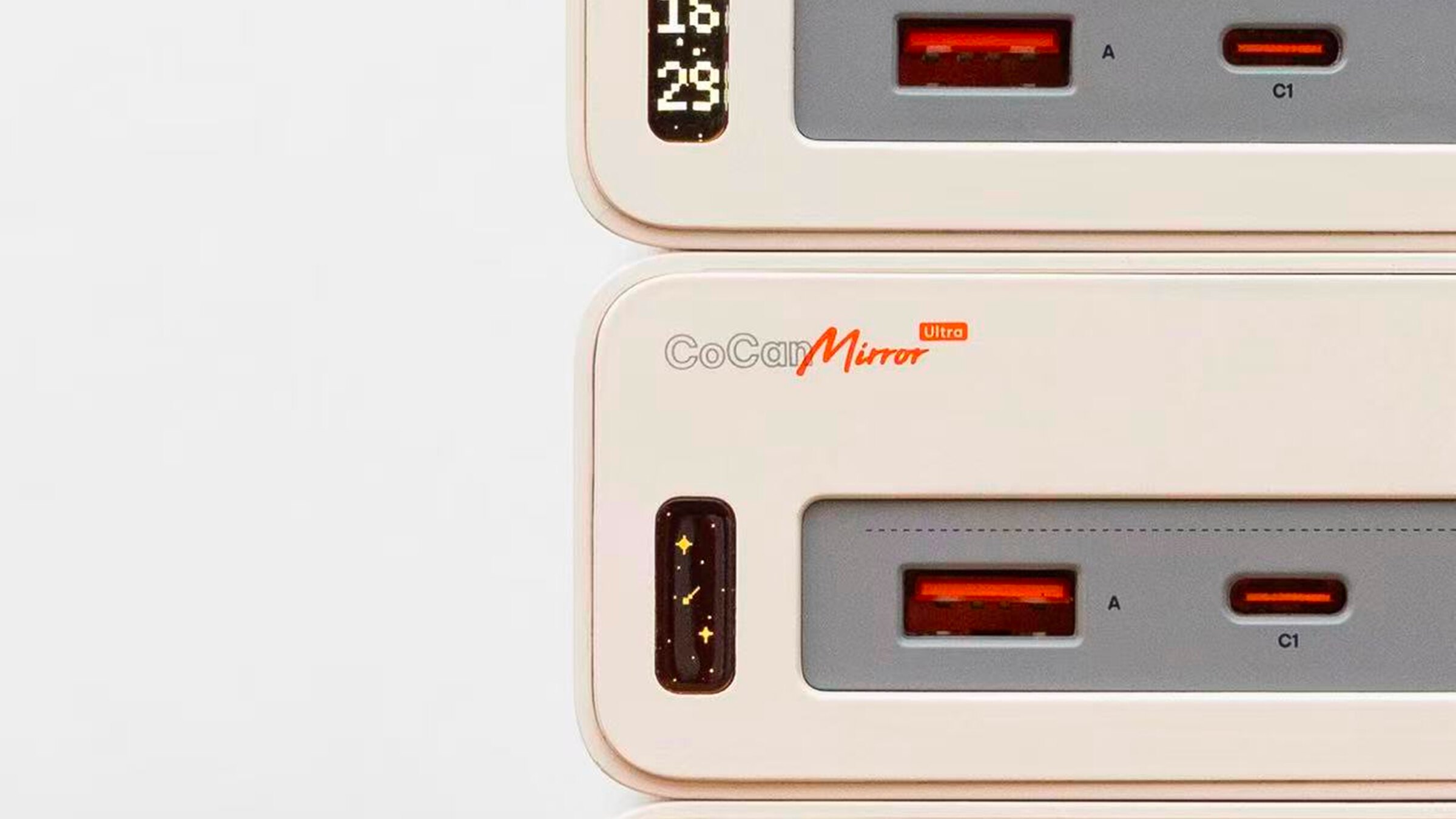

AI CoCan Mirror product line and finishes
Product Line The specifications land on visible products.

160W, up to 140W on all four C ports, ingBar, stands, and finishes come together as the complete Mirror product form.

Power

Output and power density

Total output 160W total · up to 140W on all four C ports · dual laptops share power, no dropouts · peak headroom ~200W
USB-C1 - C4 5V3A, 5V5A, 9V3A, 12V3A, 15V3A, 20V5A, 28V5A, PPS 5-21V/5A · max 140W each
USB-A 5V~20V@3A · max 60W
Efficiency / density 93.7% efficiency · ~18mV ripple · 31.94 cm³/port · 1.08 W/cm³

Form & Safety

Body, protocols, and certification

Form Detachable module · 2 rear outlets · wall-lock design
Electrical safety 105°C / 32A / 1000V limits · 64.2% derating · 1/8 load ratio
Protocols 22 protocols: PD 3.2 (AVS, high-watt PPS, EPR), Xiaomi 120W Turbo Charging, UFCS 2.0, AFC, QC2.0/QC3.0/QC3.0+, PE1.0/2.0, and more
Certifications CCC, SRRC

ingBar & Stands

One status screen, three stands.

01

ingBar display

A 0.5-inch amber OLED that breathes, chimes on the hour, and runs Conway's Game of Life; an amber filter tames blue light over recessed UV-resistant glass, nodding to 80s terminals.

02

Three stands

The Wingie butterfly stand is light and home-friendly, the Oxie stand cools to unlock a sustained 160W, and the Rhinie stands Mirror upright to save desk space.

03

Three annual awards

Weibo Digital 2025 Electronic Gadget of the Year, ChargerLab 2025 Golden Charger Award, and the AIM International Design Competition Best Technical Innovation Award.

Output specs

160W total, with up to 140W on all four C ports.

160W of total DC output lets Mirror serve several demanding devices at once. All four USB-C ports support 5V3A, 5V5A, 9V3A, 12V3A, 15V3A, 20V5A, and 28V5A, plus PPS 5-21V/5A, up to 140W per port. These tiers cover phones and tablets through laptops and handhelds — big loads and small alike.

All four USB-C ports support up to 140W, with output scheduled in real time from the shared 160W budget. No need to hunt for the strongest port. Two laptops share power without dropping out. USB-A reaches 60W, keeping older cables and smaller devices useful. In testing, a 16-inch MacBook Pro drew about 139W, an iPhone 17 Pro Max about 40W, a Lenovo R9000P about 91W, and a Raspberry Pi 5 ran at 5V/5A.

Joined, the two rear outlets take a monitor, desk lamp, or speaker — no extra power strip. USB-C multi-port charging and AC supply meet in one place.

A spec sheet is there to help you check whether it covers your device mix. But these numbers aren't static — Mirror hands them to FluxAI®'s live scheduling, sparing you the chore of managing fixed power per port. The same 160W, reused more fully, gets more done.

Form, certification, accessories

A join-and-split body, built for daily carry.

Mirror joins and splits: together it's a desk power stack with two rear outlets; pull the main body off and it's a portable travel charger that sits firm in the wall. Volume runs just 31.94 cm³ per port at a power density of 1.08 W/cm³ — the world's smallest five-port integrated volume, packing four-C-one-A plus AC into a body this small.

Efficiency and headroom back the long haul. A 93.7% conversion rate, ripple near 18mV (national-standard ceiling 200mVp-p), and a 105℃ anti-saturation transformer — plus physical limits of 105℃/32A/1000V, 64.2% voltage headroom, and a one-eighth current load ratio — keep everyday operation far from the edge. It is CCC- and SRRC-certified.

Protocol coverage spans 22 fast-charge standards: PD 3.2 with AVS, high-watt PPS, and EPR; Xiaomi 120W Turbo Charging on all four ports; UFCS 2.0; AFC; QC2.0/QC3.0/QC3.0+; PE1.0/2.0; TFCP; and SFCP — with Huawei, OPPO, and vivo reaching high power over the public PPS and UFCS standards. Certifications: CCC and SRRC.

Accessories: the Wingie stand is light and graceful, the Oxie stand handles cooling and unlocks 160W sustained, the Rhinie stand seats it upright. Awards: Weibo Digital 2025 Electronic Gadget of the Year, ChargerLab 2025 Golden Charger Award, and the AIM International Design Competition Best Technical Innovation Award.

How to read this sheet

What the numbers mean is how the system uses them.

Up to 140W per port, 160W total, 4C1A, 60W USB-A, AC supply on the back — these numbers are best read inside real use. Together they're a pool of capability that FluxAI® scheduling, port priority, protocol compatibility, and cable diagnostics draw on. Read apart from the system, they don't say much.

Travel with a laptop, phone, and tablet, and four high-power C ports spare you the socket-hunting. Keep old cables and small devices on the desk, and USB-A earns its place. Leave devices on the desk for good, and the join-and-split form with rear AC matters more than sheer smallness. Which specs matter depends on how you use them.

The protocol list shows coverage, the certification list shows a compliance foundation, and full-mode OTA means the protocol list keeps growing. The specs you check today aren't the finish line — a Mirror that can OTA its protocol chip keeps growing after it comes home.

This specs page grounds the earlier chapters — experience, architecture, protocols, security, and open interfaces — in concrete numbers. Check each line against your device mix, or go back to the matching chapter to see how the system puts them to use. The numbers are the entry; the system is the answer.

Behind the numbers

160W, 4C1A, the world's smallest five-port volume — 1 replaces 7.

A laptop on the desk, a phone, a tablet, and a few small things — Mirror alone covers that daily kit. A 160W budget across 4C1A means all four C ports support up to 140W, a laptop can reach the top tier from any socket, and two laptops can pull 80W each at once. One unit stands in for seven chargers.

Volume is the real feat: 31.94 cm³ per port and 1.08 W/cm³ of power density make the world's smallest five-port integrated volume. Efficiency reaches 93.7%, ripple sits near 18 mV — well under the 200 mVp-p national-standard line. In testing, a MacBook Pro 16 pulled about 139W, an iPhone 17 Pro Max about 40W, a Lenovo R9000P about 91W, and a Raspberry Pi 5 held a steady 5V/5A.

Up front, the 0.5-inch amber ingBar keeps status in view: a breathing pulse like hot electrons inside a vacuum tube, an hourly chime, a standby clock, and a round of Conway's Game of Life as a screensaver. An amber filter tames blue light, the surface resists UV and wear, and a slight concave guards against scratches — a system interface that nods to 1980s terminals.

Accessories split by use: the Wingie mount is light and at home in a living room, the Oxie mount manages heat to unlock a sustained 160W high-energy cruise, and the Rhinie mount stands the unit upright to free desk space. Mirror received Weibo Digital's 2025 Electronic Gadget of the Year, ChargerLab's 2025 Golden Charger Award, and the AIM International Design Competition's Best Technical Innovation Award.

Margin to spare

EMI margin: the spec line you do not see in the table.

The spec table is plain: 160W, 4C1A, stack-or-split, two rear outlets. EMI measures something else — whether this machine can sit for hours beside computers, docks, audio interfaces, and dense cabling without stirring up trouble. Many high-power supplies talk only about output; Mirror turns noise margin into a number it can state clearly.

Production hardware passed the GB/T 9254.1 Class B 30 MHz to 1 GHz radiated-emission test in both horizontal and vertical polarization, with about 12 dB of minimum margin, and the AC-port conducted-emission test left about 8 dB of minimum margin. Across the full 150 kHz to 1 GHz span there are no abnormal peaks crawling toward the limits — comfortably clear of the line, a healthy production result.

In use, that means a 160W multi-port supply can live quietly on the desk. Shortwave and medium-wave reception, a desk radio, FM broadcast, the aviation band, the bands around 2m and 430 MHz, on through AV systems, audio interfaces, and dense wiring — Mirror gives full output while holding a low-interference floor, so strong current and clean airwaves share one desk.

The world's smallest five-port

The numbers have to come back to your desk and your pile of cables.

Start by mapping the specs onto your device list: a high-power USB-C laptop, a PPS phone, a tablet or handheld that lives on the desk, plus a few legacy USB-A accessories. Mirror's 4C1A and two rear outlets are built for exactly that mixed list — measured at about 139W for a MacBook Pro 16, about 40W for an iPhone 17 Pro Max, and a clean 5V/5A for a Raspberry Pi 5.

Then look at density. Each port takes 31.94 cm³, with a power density of 1.08 W/cm³ — the world's smallest five-port integrated volume; efficiency is 93.7%, and ripple goes as low as 18mV, well under the national 200mVp-p ceiling. Small, cool, and clean is what earns a permanent place on the desk.

Read the numbers with the software, too. 160W, 140W per port, 22 protocols, and CCC / SRRC certification are the hardware base; FluxAI®, MQTT, telemetry, full-stack OTA, config sync, and Pro / Ultra decide how that base grows more valuable over time. It also took Weibo Digital's 2025 Electronic Gadget of the Year, ChargerLab's 2025 Golden Charger Award, and AIM's Best Technical Innovation Award.

Tester sign-up

Leave a message